
CVE-2025-43530: Exploiting a private API for VoiceOver
Happy New Year in advance!
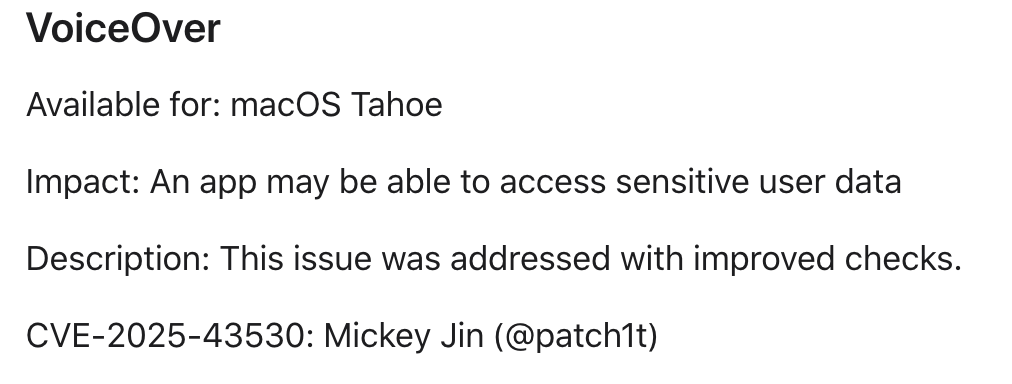
Today, I will share with you a new TCC bypass vulnerability: CVE-2025-43530. It’s about a private API within the ScreenReader.framework, a module for VoiceOver:
The MIG service: com.apple.scrod
The system MIG service “com.apple.scrod” is registered from the file /System/Library/LaunchAgents/com.apple.scrod.plist:
{
  "EnablePressuredExit" => false
  "EnableTransactions" => true
  "Label" => "com.apple.scrod"
  "LimitLoadToSessionType" => [
    0 => "Aqua"
    1 => "LoginWindow"
  ]
  "MachServices" => {
    "com.apple.scrod" => {
      "ResetAtClose" => true
    }
  }
  "ProcessType" => "App"
  "ProgramArguments" => [
    0 => "/System/Library/PrivateFrameworks/ScreenReader.framework/Frameworks/ScreenReaderOutput.framework/Resources/scrod"
  ]
}
Note that the executable /System/Library/PrivateFrameworks/ScreenReader.framework/Frameworks/ScreenReaderOutput.framework/Resources/scrod is signed with the special TCC entitlement kTCCServiceAppleEvents:
	[Key] com.apple.private.tcc.allow
	[Value]
		[Array]
			[String] kTCCServiceAppleEvents
			[String] kTCCServiceListenEvent
			[String] kTCCServiceSystemPolicyDocumentsFolder
			[String] kTCCServiceMicrophone
			[String] kTCCServiceVoiceBanking
			...
The main function is implemented in the framework /System/Library/PrivateFrameworks/ScreenReaderCore.framework:

The Vulnerability
The implementation of one MIG service routine, __SCROXGetValueForKeyWithObject, is as follows. The client-side interface __XGetValueForKeyWithObject can be directly invoked by the high-level API -[SCROScriptClient runScriptFile:] (from the private ScreenReaderOutput.framework).
// The MIG service routine is implemented in "/S/L/P/ScreenReader.framework/Versions/A/Frameworks/ScreenReaderOutput.framework"
int __SCROXGetValueForKeyWithObject(...)
{
    ...
    x0_1 = _SCROUnserializeWrapper(arg4, arg5, arg6, arg7, &cf_1);
    if (!(uint32_t)x0_1)
    {
        v1 = arg13[1];
        int128_t var_90 = *(uint128_t*)arg13;
        int128_t var_80_1 = v1;
        int64_t isClientTrusted = [SCROClient isClientTrustedWithPortToken:&var_90];
        id sharedServer = [[SCROServer sharedServer] retain];
        id deletage = [[sharedServer delegate] retain];
        id obj = nullptr;
        id x0_13 = [deletage getValue:&obj forKey:arg3 withObject:cf_1 handlerType:(uint64_t)arg2 trusted:isClientTrusted];  // invokes the delegate method
...
}

// the delegate method is implemented in scrod:
-[SCRODMain getValue:forKey:withObject:handlerType:trusted:] (...) {
...
	-[SCRODScriptHandler handleGetValue:forKey:withObject:trusted:](...);
...
}

-[SCRODScriptHandler handleGetValue:forKey:withObject:trusted:] (...) {
  if ( getuid() )
  {
    if ( isTrusted ) // <-- run the specified AppleScript only when the XPC client is trusted.
    {
      if ( key == 104 )
      {
      	[self _handleRunAppleScript:object];
      	...
     	}
    }
    ...
}
This service routine will invoke the function -[SCRODScriptHandler _handleRunAppleScript:] only when the XPC client isTrusted. This is checked in the following function:
// implemented in "ScreenReaderOutput.framework"
bool +[SCROClient isClientTrustedWithPortToken:](Class self, SEL sel, void* token)
{
    int64_t x0_1 = j__audit_token_to_pid(&var_1070);
    id __ClientTrustDictionary_1 = __ClientTrustDictionary;
    id obj_2 = [[NSNumber numberWithInt:x0_1] retain];
    id obj_1 = [[__ClientTrustDictionary_1 objectForKey:obj_2] retain];
		if (!obj_1)
		{
		    cf = j__SecTaskCreateWithAuditToken(0, &var_1070);
        if (!cf) goto NEXT;
        CFTypeRef x0_6 = SecTaskCopyValueForEntitlement(cf, @"com.apple.private.tcc.allow", 0);

        if (!x0_6) goto NEXT;
        if (j__CFGetTypeID(x0_6) != j__CFArrayGetTypeID())
        {
        NEXT:
            int64_t pid = j__audit_token_to_pid(&clientPath);
            j____bzero(&clientPath, 0x1000);
            if (j__proc_pidpath(pid, &clientPath, 0x1000) <= 0)
                isTrusted = nullptr;
            else
            {
                id obj_3 = [[NSString stringWithUTF8String:&clientPath] retain];
                url = [[NSURL fileURLWithPath:obj_3] retain];
                [obj_3 release];

                if (isTrusted)
                {
                    +[SCROClient isClientTrustedWithPortToken:].cold.1(url, &arg2);
                    isTrusted = arg2;
                }
            }
        }
...
}

void +[SCROClient isClientTrustedWithPortToken:].cold.1(id arg1, char* arg2) {
   id x0_10 = [arg1 retain];
    id x0_11 = [[NSData dataWithBytesNoCopy:&__isURLSignedByApple.kCodeSignRequirement length:0x10 freeWhenDone:0] retain]; // "anchor apple"
    if (!x0_11)
        x22 = -0x6c;
    else
    {
        OSStatus x0_1 = j__SecRequirementCreateWithData(x0_11, 0, &var_40);
        if (x0_1)
            x22 = x0_1;
        else
        {
            x22 = j__SecStaticCodeCreateWithPath(x0_10, 0, &codeRef);
            if (!x22)
            {
                x22 = j__SecStaticCodeCheckValidity(codeRef, 4, var_40);
                if (!x22)
                {
                    x22 = j__SecCodeMapMemory(codeRef, 0);
                }
            }
        }
    }

    *(uint8_t*)arg2 = (char)(!x22 ? 1 : 0);
}
This verification logic contains at least two security issues:
-
If the XPC client is signed by Apple (csreq string: “anchor apple”), then it will be trusted. However, it is easy to inject into an Apple-signed executable. For example, the command
ssh -I payload.dylib root@localhostcan be used to inject thepayload.dylibinto Apple-signed system binary/usr/libexec/ssh-apple-pkcs11. (This command does not need to be run with root privileges.) -
It validates the XPC client by using the API
SecStaticCodeCreateWithPath, instead of using the client’s audit token. This can be bypassed via a TOCTOU attack.
As a result, an attacker can execute arbitrary AppleScript files and send AppleEvents to any target process (such as Finder), thereby completely bypassing the TCC protection mechanism.
Please note that other MIG service routines are similarly affected by this check (isTrusted), which may also be exploitable:
__XRegisterWithServer
__XSendEvent
__XRegisterForCallback
__XGetCallbacks
__XSetValueForKey
__XGetValueForKey
__XGetValueForKeyWithObject // exploited by this report
__XPerformAction
__XPing
The Exploit
The exploit code has been uploaded here.
The demo video link:
https://youtu.be/DjcOuZOHTeA
Patch in macOS 26.2
Now, only processes with the entitlement “com.apple.private.accessibility.scrod” are trusted:
BOOL +[SCROClient isClientTrustedWithPortToken:](id a1, SEL a2,void *atoken)
{
  v3 = (void *)xpc_copy_entitlement_for_token("com.apple.private.accessibility.scrod", &atoken);
  v4 = v3;
  if ( !v3 || xpc_get_type(v3) != (xpc_type_t)_xpc_type_bool_ptr || (v5 = 1, !xpc_bool_get_value(v4)) )
  {
    v6 = audit_token_to_pid((audit_token_t)atoken);
    v7 = (void *)_SCROD_LOG();
    v8 = objc_retainAutoreleasedReturnValue(v7);
    if ( os_log_type_enabled(v8, OS_LOG_TYPE_DEFAULT) )
    {
      buf[0] = 67109120;
      buf[1] = v6;
      _os_log_impl(&dword_7FFD001DB000, v8, OS_LOG_TYPE_DEFAULT, "Missing Entitlement for pid: %d", (uint8_t *)buf, 8u);
    }
    objc_release(v8);
    v5 = 0;
  }
  objc_release(v4);
  return v5;
}
On the other hand, the entitlement is validated through the client’s audit token rather than the API SecStaticCodeCreateWithPath. Therefore, TOCTOU attacks will not be effective.
Bye, 2025
Time flies, and in the blink of an eye, we have reached the end of 2025. This year has seen many developments.
I maintained my consistently high productivity in vulnerability research, submitting over 60 reports to Apple. (Since July 2020, I have received over 300 CVE credits from Apple. More details of these vulnerabilities will be disclosed gradually in the near future.)
This year, I entered into marriage, and my wife is now pregnant. Consequently, in 2026, I will dedicate most of my time to my family, and my vulnerability research work will be scaled back accordingly. Therefore, my output in the coming year is likely to be limited.